
Mood: Mildly Panicked | Post Type: Behind the Scenes | Weeks Until Show: 33
The Panic Arrives
As we roll into January, the panic is creeping in. I genuinely have no idea how we’ve travelled from July 2025, when I first booked my Solo Show, to January 2026 so quickly. For a moment it even crossed my mind to push the show back — but I’ve already spoken about it to so many people at my December events, and I’ve since received emails asking exactly when and where.
To calm myself, I started mind-mapping everything I need to consider. At first, I thought it wasn’t the organisation that filled me with dread, but whether I could create enough work for the show — or so I believed. This weekend, however, taught me a far more uncomfortable lesson about leaving things too late.
My Confidence Fell Out of a Frame.
I needed to frame two pieces for a group exhibition. The glass itself had been fused months ago and I’d been showing them at my Christmas events when people were intrigued by my larger work.
The irony was that these two pieces only needed grinding and polishing. I’d been stalling on this stage because I was waiting for a 100-grit disc pad to speed up the glass removal process. I’d bought a very cheap imported version — sprayed grit rather than electroplated — because I wanted to test it before writing a blog about how I’d built my flat lap grinder from a pottery wheel. With £175 discs out of reach for many, I wanted to see if a £30 alternative could work.
Over the Christmas break I finally found time to mount the disc and give it a go. It did remove the glass, but I worried it was too aggressive and switched back to 200-grit, taking things more slowly. In reality, once I’d committed, the whole process took only a few hours. While polishing I even managed to phone my mum — she couldn’t hear the pottery wheel at all, which is surprisingly useful to know for future time-pressured catch-ups.
Still, this combination of hesitation and tinkering meant it had taken me months to finish just two pieces. And I need twenty-four!
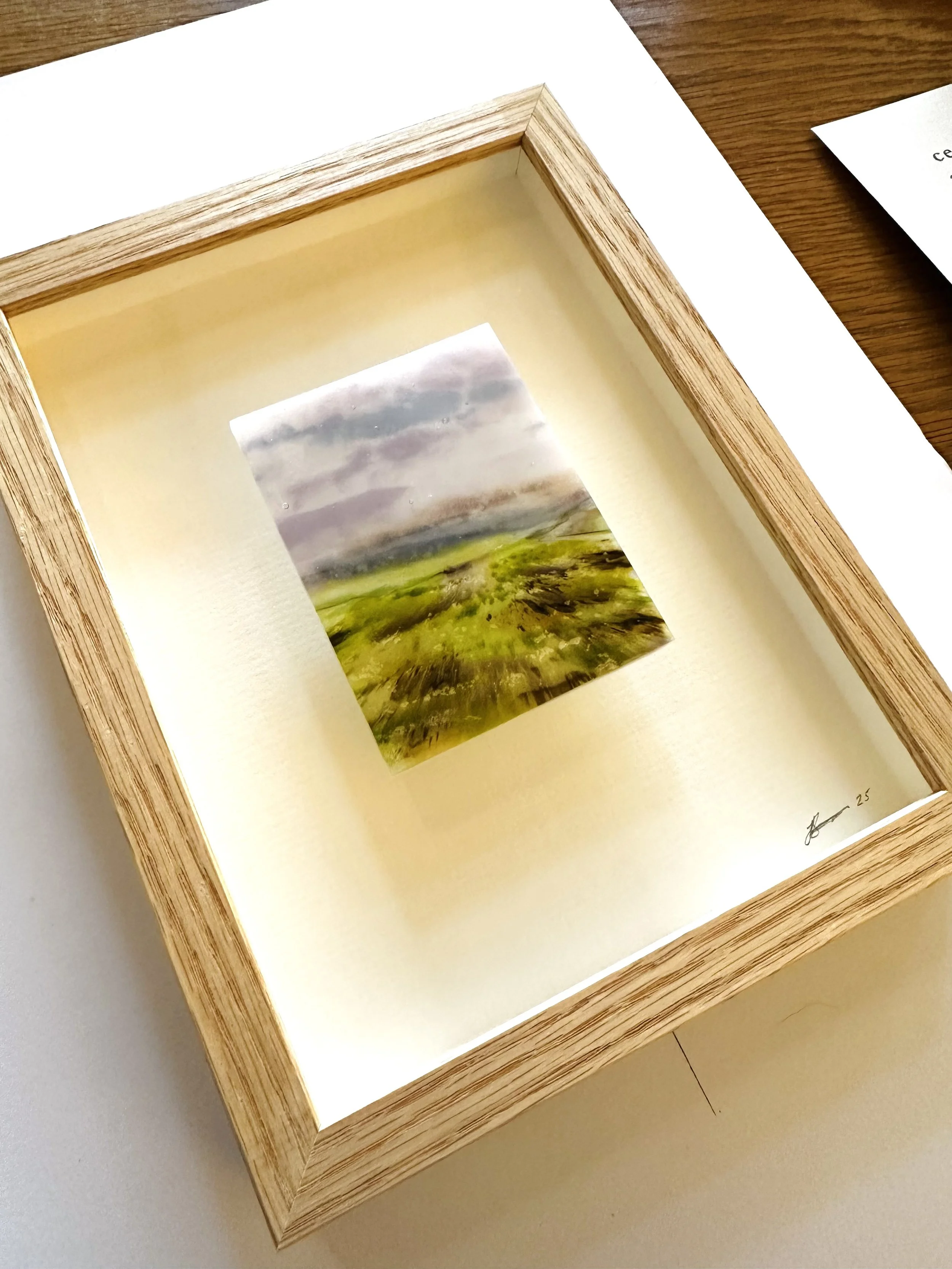
Framing the first piece ‘Shifting Violet’ went okay — not smoothly, because I find the whole process stressful. Making a shadow mount that fits is an art form in itself: a millimetre makes all the difference. Then there’s gluing the glass, making sure it’s perfectly straight, battling dust and smears despite cotton gloves and lint cloths. But I kept my cool.
The second, however, turned into a ‘Mr Bean’ episode.
The Frame That Undid Me
I’d ordered custom frames from a UK framing company — who will remain nameless, although I may yet be sending them a strongly worded email… or perhaps just a link to this blog. I’d hoped to rely on them for all my framing for the solo show — until now (sadly not the first mistake).
I’d mounted ‘Granite & Time’ onto UltraVue anti-reflective glass, a premium option chosen for its exceptional clarity and because it doesn’t visually compete with my work (although it certainly competes on price). When I went to place it into the frame, the glass dropped. The framing glass was 5mm too short. The top edge sat visibly lower than the inside of the frame.
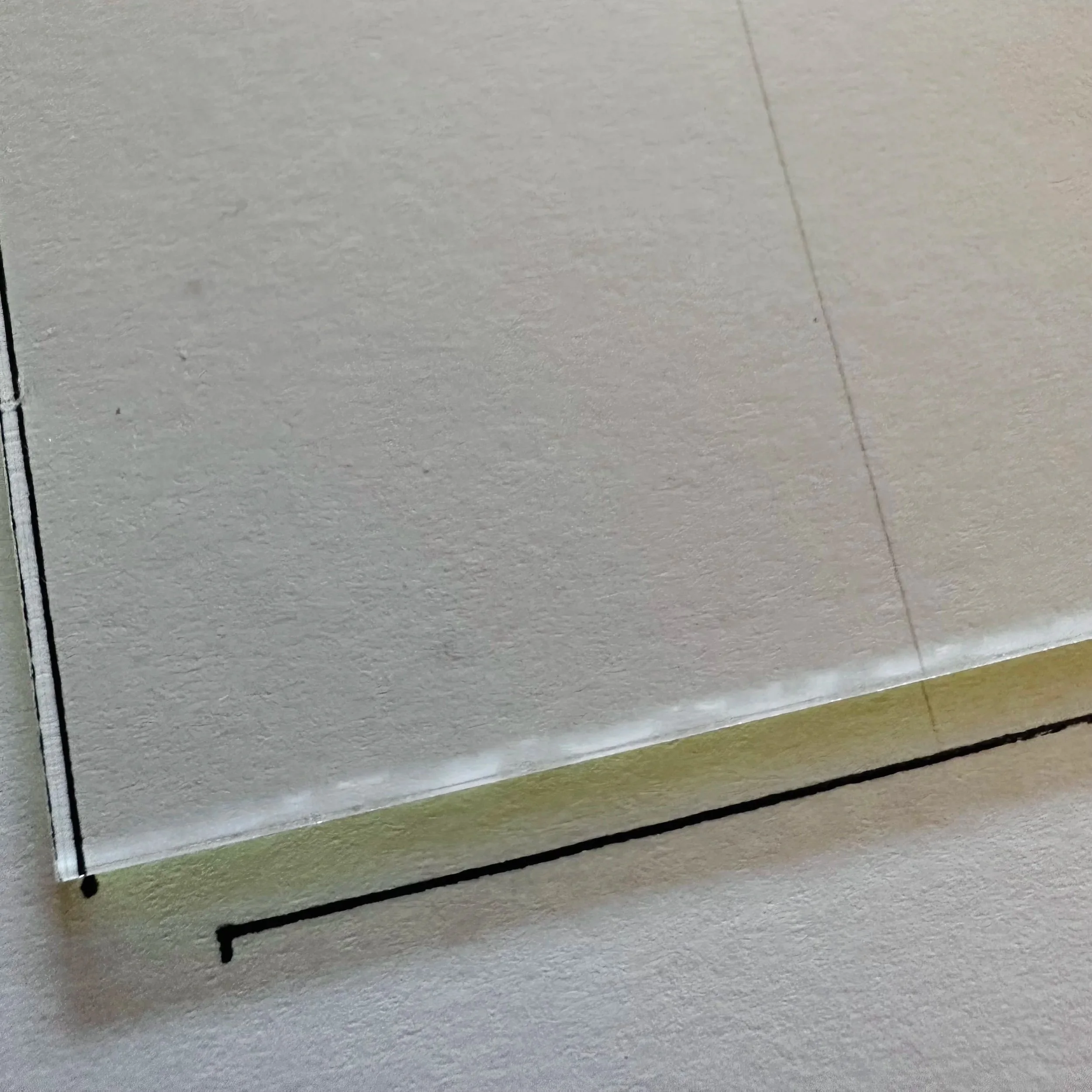
I tried wedging it in place by super-gluing mount board at the top and bottom. I reassembled the frame. It dropped again — to the point it nearly fell out.
My glass was glued on.
What followed was ninety minutes of frantic research, then a careful combination of acetone, a hair dryer, a blade, and fishing wire. Eventually the piece came free — but I was left with only one framed work to deliver to the curator that evening instead of two. The exhibition was being installed the following day, with the opening just two days away.
I felt embarrassed, angry with the framers, furious with myself for leaving it so late (a point my husband reminded me of — the truth does hurt), and completely overwhelmed. In the grand scheme of things, it’s hardly a world problem — but in that moment, it consumed everything.
That was the point I realised I can’t allow this to happen with my solo show. My original plan was to make as much work as possible and only think about framing towards the end. Now I know that unless I change my framing process entirely, framing has to happen alongside the making — not after it. Because if two pieces can unravel me like that, I can’t even imagine the stress of trying to frame twenty-four.
The Lessons Hidden in a Framing Disaster
I didn’t expect a five-millimetre mistake to stop me in my tracks — but it did. Not just because a frame didn’t fit, or because I missed a deadline, but because it exposed a much bigger truth about how I’ve been working. Writing this blog has helped me to realise eight lessons:
1. Framing is part of the artwork, not an afterthought.
I can’t treat framing as the final, mechanical step. It influences the success of the piece just as much as the glass itself.
2. Decisions delayed become decisions forced.
By postponing choices about frames, sizes, and presentation, I’m not buying myself thinking time — I’m creating pressure.
3. Systems must grow with the work.
What works at small scale won’t necessarily hold when my work gets bigger. My mountboard shadow-box method may not be structurally sound as pieces increase in size.
4. Trust needs testing.
Suppliers shouldn’t become “the solution” until they’ve proven consistency. Ordering through a website and only discovering problems when something goes wrong isn’t a relationship — I need to build connections slowly and, where possible, in person before relying on them.
5. Stress reveals weak points.
It wasn’t the glass that failed — it was the process around it. This is the part of my practice that now needs as much attention as my making.
6. Presentation is a creative choice, not just a technical one.
Oak or white frames aren’t a detail — they’re part of the language of the work, especially when coastal pieces may speak differently to moorland ones.
7. My solo show requires a new way of working.
I can’t rely on how I’ve always done things. This exhibition demands a more robust, repeatable, calm process — not heroics at the last minute.
8. Panic is feedback.
The intensity of that moment wasn’t failure — it was information. It showed me exactly what needs to change before August arrives.
Finding my Framing Hero
Writing this blog has been a cathartic process, and it’s helped me clarify what happens next. I spoke with the curator when I dropped off the one framed piece, and although the exhibition opens on Wednesday, I’ll deliver the second on Friday for her to hang when she’s next in the gallery.

I’ve also already found my framing hero: Andy from SOTA Gallery in Witney, Oxfordshire. I phoned him on Monday morning and explained my weekend disaster, and he simply said, “Pop in and I’ll cut the glass while you wait.” What followed was an impromptu mentoring session — incredibly generous with his time and knowledge — and a chance to explore some beautiful frame options alongside their stunning artwork.
They may be 160 miles from home, but they’re close to both my day job and my mum, and what I really need now is a reliable framing relationship. When I’m next up that way I’ll be ordering a few designs — and after this experience, that will be very soon.
This is Episode 13 in my ‘Solo Show Diary’ series — a behind-the-scenes look at how my work develops. You can find my earlier posts here.