When the Studio Is Out of Reach
Mood: Quiet momentum | Post Type: Behind the Scenes | Weeks Until Show: 29
When Time Feels Scarce
They say “time is our greatest commodity,” and those words feel deeply true. More often than not, I feel a sense of frustration that comes from being time-poor. I’m unable to make work consistently, partly because I’m away from home most weeks wearing my other professional hat, and partly because when I am home it can take days to recover from sheer tiredness. Surgery in 2025 pushed me into menopause in my forties, intensifying that fatigue in ways I hadn’t anticipated. The travel is taking its toll.
The Reality Behind the Romance
This isn’t a pity party — it’s simply my reality. I often catch myself thinking that if this were my full-time practice, everything would be different: calmer, more spacious, a version of my “happy place.”
But I’m wise enough now (or perhaps I’ve listened to enough creative podcasts) to know that this is far from the truth. Being a full-time artist still means earning an income — restocking galleries, building inventory for events, teaching, or finding other ways to sustain the practice.
I’m acutely aware that my day job is what makes my life as a glass artist financially possible. So the task becomes one of acceptance, paired with strategy. Rather than focusing on what I can’t do, I’m trying to work out a master plan for what can be done when I’m away. Even after an eleven-hour workday, there are still small pockets of time available — moments that can be used for organising, planning, learning, and quietly moving the work forward.
Creative Thinking and Practical Planning
There are two distinct areas I’m working within. Although both are forms of learning, one is creatively led — exploring ideas, testing images, and thinking conceptually — while the other is focused on the practical task of organising a solo show.
And yes, Chatty G (ChatGPT) makes many appearances. Partly because, frankly, who else is going to listen? But more seriously, having a tool that can critically engage with my thinking has made a significant difference. Using technology in this way helps me bring structure and logic to what is often a messy, intuitive thought process.
Putting the Framework in Place
Digital groundwork - Digitally, there is also a great deal I can move forward. I can begin building the sales pages for the website — my intention is to create an individual store page for each piece, accompanied by a QR code placed beside the work on the wall. This allows visitors to engage more deeply, reading about each piece online while still standing in front of it. Actions I can take now:
Create individual sales pages for each piece
Write extended descriptions to sit alongside the work
Generate QR codes linking directly to each page
Integrate these quietly into the exhibition experience
Wall logic and numbers
Alongside this is the practical work of show planning, and this is an area where I’ve already made tangible progress. I started with an initial outline, but I’ve since reviewed the wall plan in detail. I’m now fully aware of my minimum target numbers per wall, and locking in these decisions feels key to moving forward with clarity. What’s now in place:
A reviewed and refined wall plan
Clear minimum target numbers for each wall
Key decisions locked in to support forward momentum
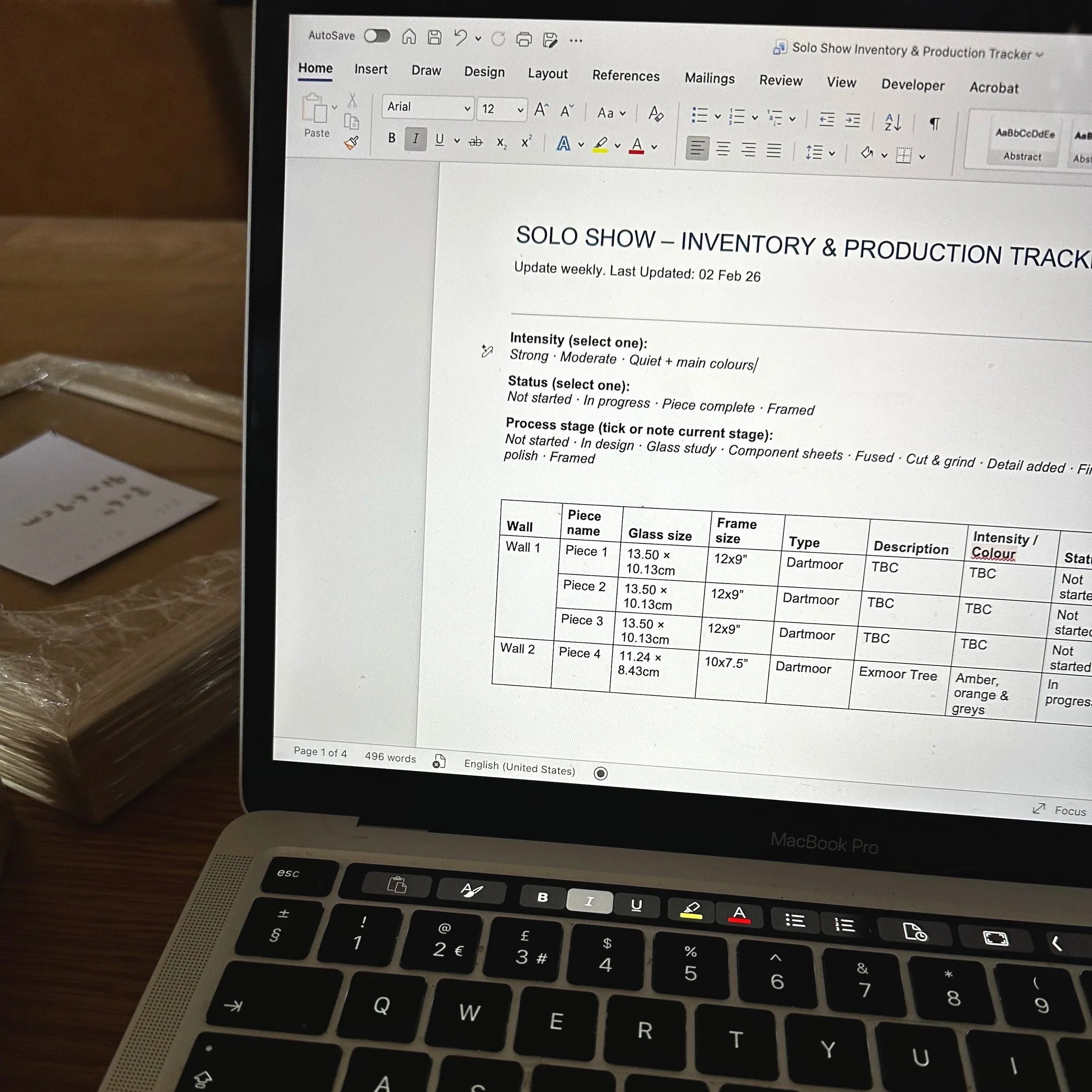
Seeing the whole – I’ve also created a comprehensive inventory list, which allows me to see the exhibition as a whole rather than as individual, isolated pieces. Each work is now tracked by:
Working title
Glass size and frame size
Coastal or Dartmoor body of work
Colour theme
Overall status (not started, in progress, complete, framed)
Detailed process stage — from design and glass studies through to firing, finishing, and framing
Supporting materials – While still on the to-do list, I’ve also begun thinking ahead to the supporting materials. These aren’t yet made, but they are now firmly part of the plan — and that, in itself, feels like progress. Next to be developed:
Flyer templates
Wall label layouts
Price list
Private view invitation
Continuing the Creative Learning
I also mentioned that my learning continues. At the moment, I’m working through how to incorporate light into my landscapes, particularly when upscaling a successful pendant. At a smaller scale, light isn’t critical, but in larger works, if it’s left unconsidered, the pieces no longer read as art.
I’ve long recognised that understanding light is something of a blind spot for me, and this realisation has opened up a new area to explore. When the pressure — and occasionally the overwhelm — is stripped away, this is the part of the journey I enjoy most. Being an artist means constant learning and evolution, and it’s within that space that I feel happiest.
This is Episode 15 in my ‘Solo Show Diary’ series — a behind-the-scenes look at how my work develops. You can find my earlier posts here.