Admissions from the Studio
Mood: Excitedly flustered | Post Type: Behind the Scenes | Weeks Until Show: 3
Missing the Deadline
With less than three weeks to go until my first solo exhibition, I have a few admissions to make.
The first is that, after a year of writing these blogs, I finally missed my fortnightly deadline. It's a first. They've been getting closer and closer to the wire, but this time the wire won.
Surprisingly, I'm not beating myself up about it. Over the past few months I've been trying to be kinder to myself. Instead of asking, "Why haven't I done enough?" I've been asking, "What's the worst that can happen?" Missing a blog isn't ideal, but neither is treating every missed deadline as a personal failure.
The Return of the Lists
If you've been following these blogs, you'll know that in my last post I decided to stop writing lists. Every morning I used to write down everything I needed to do. Every evening it became a reminder of everything I hadn't managed to achieve. It slowly built into the feeling that there simply weren't enough hours in the day.
My three lists – home, work and glass – had become less of a guide and more of a beating stick. For about four weeks it felt wonderfully liberating. Then reality caught up with me.
Those lists weren't something I started on a whim. They were a strategy I developed in my early twenties to help manage my neurodiversity, especially as life became more complicated with work and all the responsibilities that come with being a grown-up. This week I was reminded exactly why I'd created them in the first place. Out of sight really is out of mind for me. I started forgetting appointments and important jobs, and realised that perhaps I'd thrown out something that was genuinely helping me.
So, reluctantly, the lists are making a comeback. Just, perhaps, in a much gentler form.
Making Space to Think
What I haven't gone back to is writing down on the list every stage of my making process. I already know what comes next.
The truth is that creating my glass pieces is often about 80% process and 20% creative decision-making. Whether it's choosing four layers for a pendant or designing a larger wall piece, that's only the first creative decision. Once the glass has been fully fused there's cutting on the tile saw, shaping, levelling, grinding through progressively finer grits, and only then does the creative side begin to reappear before it's back into the kiln for the final fire polish and then into the finishing process again.
For years I'd write, "Today I will..." followed by the next process. I don't need to anymore. By not writing down every technical step, I gave myself room to think. And that space has changed more than I expected.
Breaking My Own Rules
With less than three weeks before an exhibition, I decided to change my process. Not exactly Art Exhibition 101 timing.
For the last year, I've cut out the final shape immediately after fully fusing the four layers of glass. It worked, but it also meant I was making compositional decisions while looking at a dull, matt surface. The glass only hinted at its true colours when I splashed water over it to mimic the glossy finish. My composition viewfinder and marker pen, unfortunately, don't work underwater.
So this time I tried something different. I fire polished the whole piece before cutting the final composition.
There are downsides. It takes up much more room in my little kiln, and because the whole surface has been fired, it needs considerably more hand sanding with 400 grit to flatten it. Any slight indentation from the kiln shelf or kiln paper has to be removed, and I simply don't have the strength to do that in one sitting, so it's spread over several sessions.
A Crisp Edge
But the advantages have surprised me. For the first time I can see the piece as it will actually look before deciding exactly where to crop it. If bubbles appear or a matt area develops, I can adjust the composition rather than hoping my original plan still works.
It has also reduced work later in the process. One of my aims has always been for my finished pieces to have crisp, clean edges, rather like the edge of a stretched canvas, rather than the softened, rounded edge that naturally comes from fire polishing.
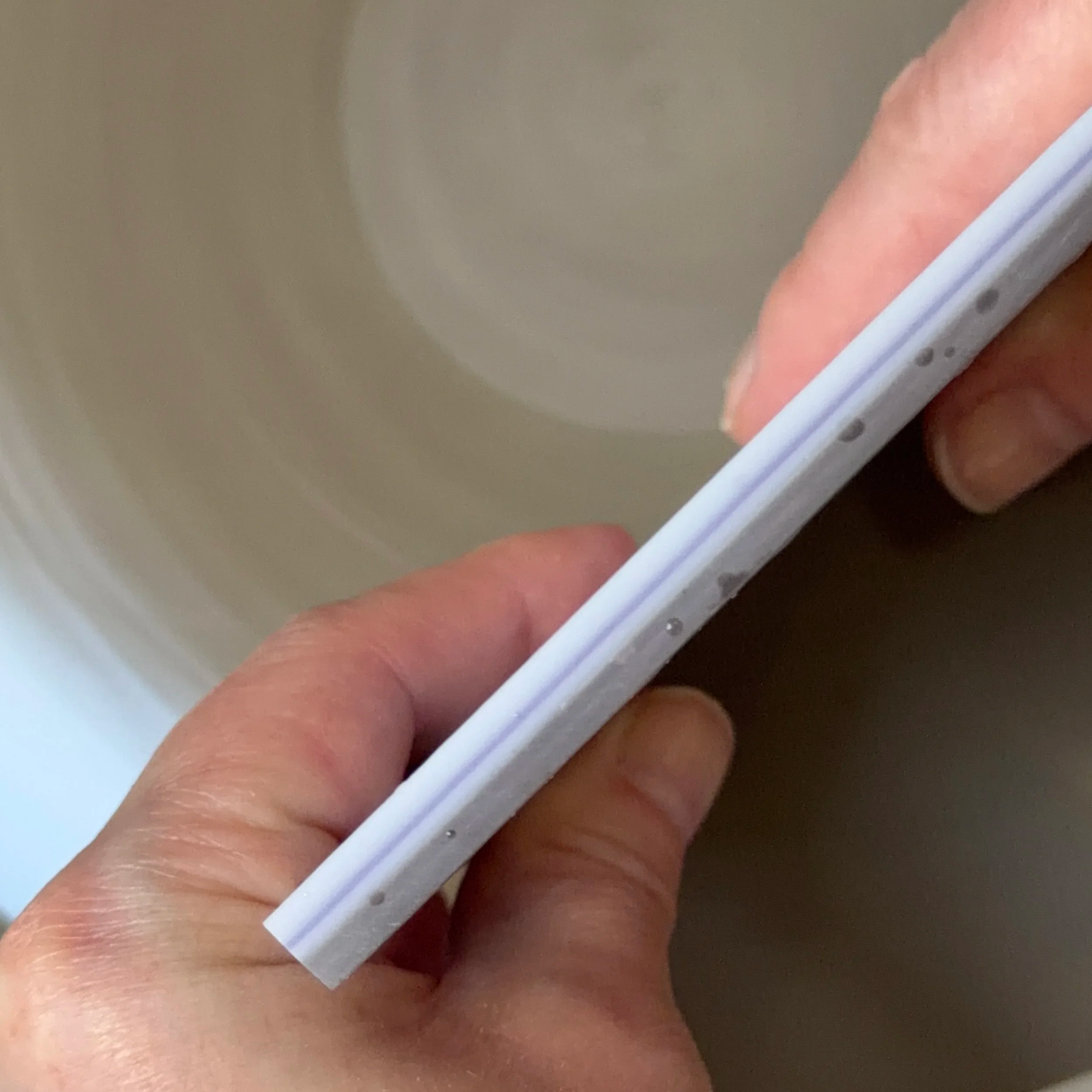
Grinding the edges of a larger landscape
Using my previous method meant I had to cut the composition oversized because I knew the edges would round over in the kiln. Afterwards I'd spend a long time ( a really long time - hours) grinding everything back to regain those crisp edges.
By fire polishing first, I can now cut much closer to the finished shape. There's less glass to remove and far less grinding afterwards. Considering how many pieces I still have waiting to be ground using the old method, I rather wish I'd thought of this sooner.
I Know… Radical!
Then, just when I thought I'd finished experimenting, another idea appeared. My work has always begun as a rectangle. Since developing my pendant designs, I've worked in a 4:3 ratio, and my framed wall pieces have naturally followed the same proportions.
But as I'd increased the size, I'd run into the same problem every time. The larger the piece, the more the glass spread during firing. My carefully designed horizon line would bow, I'd lose sections of sky and shoreline, and compositions I'd spent hours refining often ended up in the off-cut bucket.
Then I wondered... "What if I started with a square?" I know... radical! But it may turn out to be one of the biggest changes I've made. I've already fused my smallest and medium-sized pieces this way, and a larger version is currently making its way through the kiln. Early results suggest the glass spreads much more evenly. I'm still losing some of the design, but nowhere near as dramatically. Instead of sacrificing large areas of sky or shoreline, I have much more freedom when deciding the final composition.
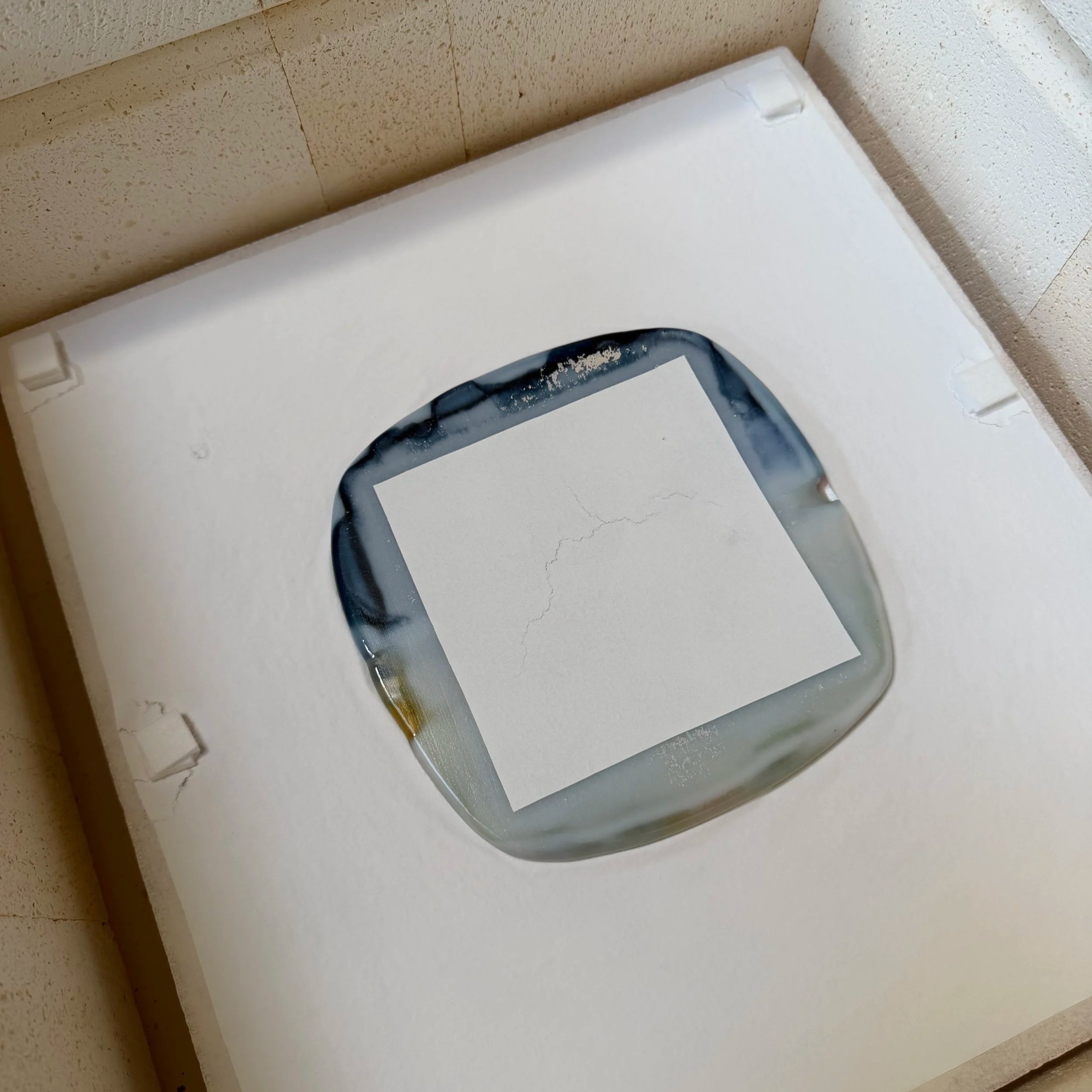
The new square design compressed after are full fuse
What's Next?
Ironically, although there's more waste on paper because I'm starting with a square, some of those offcuts have become interesting in their own right. They've already earned a place on my "after the exhibition" list of ideas. Which is reassuring. Because if I'm honest, there has always been that little question quietly sitting in the back of my mind..."What's next?"
My Final Admission
I'm probably not going to reach my goal of producing work at my largest intended size of 18 × 13 cm for this exhibition. There are simply too many edges still waiting to be ground, pieces to finish and frames to prepare, many of them made using my previous process.
A few weeks ago I'd probably have seen that as a failure. Now I don't. Yes, I'm disappointed, because that larger size has been something I've been steadily working towards. But I've also learnt more about my process in these last few weeks than I could have imagined. I've discovered a better way of working, found a solution to problems that have frustrated me for years, and stumbled across a completely new way of building my compositions that I genuinely think could shape the work I make after this exhibition.
Perhaps that's my final admission. Being creative isn't about having everything figured out before the gallery doors open. It's about being willing to keep learning, questioning and adapting right up until they do.
This is Episode 28 in my ‘Solo Show Diary’ series — a behind-the-scenes look at how my work develops. You can find my earlier posts here.